A landing page used to cost me an afternoon. Now it takes a few minutes, and I’m not the one building it.
My partner and I run 3 businesses: a farm growing cut flowers and truffles that’s moving into agritourism, my own business, Milking Ducks, and AgSide, the agritourism tech platform I’m building now. There’s no marketing team, no ops manager and no assistant quietly fixing my calendar. For years, running it all felt like trying to milk a duck: unnecessarily hard, slightly ridiculous and messier than it needed to be.
Then, a few months ago, I stopped asking AI to help me and started asking it to do the work. My to-do list started moving for the first time in years.
The loop that was eating my week
If you run a small business, you know this loop.
You’re halfway through something when you think, we need a landing page for that workshop. Or someone should follow up those enquiries. It goes on the list. The list grows. Days later, sometimes weeks, you get to it.
Then the real time sink starts. 3 YouTube tutorials, 2 of them out of date. A free trial of yet another tool. You fiddle, get distracted, come back, and a small job swallows the afternoon.
I’ve spent 20+ years improving how businesses work, so I always knew what needed doing. That was never the problem. Knowing what to do and having the hands to do it are 2 different problems. AI solved the second one.
Most of us are using AI wrong
Most small business owners use AI like Google with better manners. Ask a question, get an answer, copy the useful bits, then go and do the work yourself.
I did that too. Then I moved on to drafting: emails, captions, outlines, first passes at copy I’d rewrite anyway. Helpful, but AI was still a fast intern handing me notes. I still had to open a handful of tools and make the thing happen.
Now I don’t ask Claude to help me write a landing page. I ask it to build the page, connect the sign-up form to my email platform and put it live. It does.
The way I explain it: chat AI is a brain. Connect it to your email, website, files and calendar, and it grows arms. A brain with arms gets things done.
The 6 jobs AI does for me now
These are the roles I’d hire if I had the budget. They’re also the jobs most small business owners are doing badly at 10pm.
1. Social media manager. Every morning at 7am, a batch of reel scripts lands in my inbox: a series on AI and a series on running a better business. AI writes them in my voice and grades them before they reach me. Anything scoring under 9 out of 10 never arrives. A weekly report shows what’s performing, so I decide on numbers, not vibes. I cancelled a paid content tool because I’d rebuilt the parts I used.
2. Web developer. I moved the Milking Ducks website off WordPress and rebuilt it from scratch with AI doing the build: new pages, a members-only resources area, and an interactive business health check that scores answers automatically. A year ago, that was a developer’s invoice. Now it’s a conversation.
3. Marketing and sales coordinator. Custom sign-up forms on my site feed straight into my email platform. I’m building email automations flow by flow: newsletter, quiz results, resource requests. Enquiries and follow-ups live in a system now, not in my head at 2am.
4. Data analyst. I have a Master of Analytics, so I love a good dashboard. I hated the hours it took to build one. Now I describe what I want to see, and AI builds it on live data, not a spreadsheet I forgot to update.
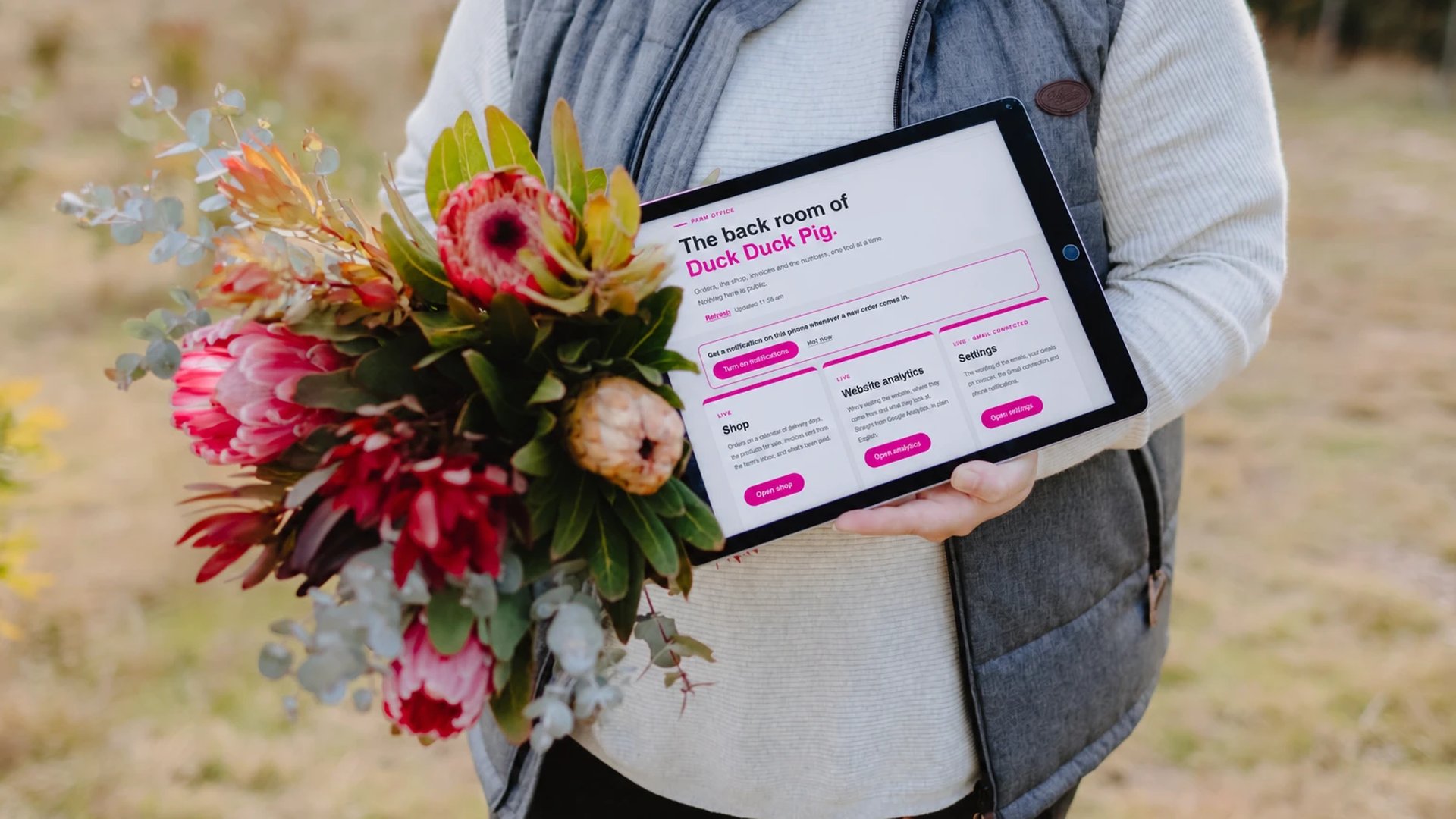
5. Operations manager. This one matters most. The admin portal on my website is my business HQ: social scheduling, tasks, everything that stops 3 businesses falling over.
It’s lightened the load on the farm too. Our custom farm app holds every order and delivery together. An order comes in, our phones ping, and the app adds it to the calendar. We track it from new, to confirmed, to delivered. On delivery runs, I tap the address and Google Maps opens. No hopping between emails, apps and handwritten notes on the back of an envelope.
6. Personal assistant. Sorting the inbox, drafting replies, pulling our calendars together and chasing what I’d otherwise forget. AI handles the unglamorous stuff that eats your week.
What it looks like day to day
I still have a to-do list. I haven’t handed the business to a robot and gone to the beach.
What’s changed is what happens when something lands on the list. The thinking is still mine: what needs doing, why, and what good looks like. The doing has collapsed. Jobs that took hours of research, tool-hopping and building now take a few minutes. The fiddly ones take longer, and I check and approve everything. But I ask Claude to do it, and it does.
That changes the maths of a small business. When a task costs an afternoon, you put it off. When it costs a few minutes, you do it. The “one day we should” list stops being a graveyard and becomes a pipeline.
AI amplifies whatever’s underneath
This is the part nobody selling AI shortcuts tells you. If your processes are a mess, AI helps you do messy things faster. The owners getting the most from it aren’t the most technical. They’re the ones who’ve thought about how their business works.
- It doesn’t replace judgement. AI is brilliant at doing the thing. It’s useless at deciding whether the thing is worth doing. That’s your job.
- There’s a learning curve. I’m technically non-technical, and I’ve put serious hours into this. It’s not hard, but setting it up properly takes time.
- You still check the work. Nothing goes live without me looking at it. Think of it as a capable team that still needs a manager.
If you’re still using AI like Google, start here
You don’t need to rebuild your website next week. Start smaller.
- Teach it your business. Give it context first: what you sell, who buys, how you sound. Generic input gets generic output.
- Pick 1 annoying, repetitive job. Not the impressive one. The one that keeps getting pushed to tomorrow.
- Connect 1 tool. Email, calendar or files. This is where AI goes from brain to arms.
- Ask it to do, not draft. Next time you’d ask “how do I…”, ask it to do the thing. Then check it, tweak it and approve it.
1 job, 1 tool, 1 week. Then pick the next one.
The point isn’t the tech
I didn’t get into this because I love tech. I got into it because I was stretched across 3 businesses with no team and a to-do list that only grew. AI didn’t make me superhuman. It gave me the hands to do what I already knew needed doing.
That’s what I want for other small business owners. Not more tools or more hustle. Time back, better decisions, and a business that doesn’t need you holding it together with sticky tape.
If any of this sounds familiar, or it’s something you’d like to tackle in your own business, join the Milking Ducks membership. You don’t have to be an AI expert to start. You have to be curious and willing to be a beginner. Confidence comes after you start, not before.