
That’s our farm invoicing. It used to take 20 minutes. Now it takes 2, and everyone wants to know which AI tool did it. Fair question. Wrong question.
Before we went anywhere near AI, we pulled the whole process apart. What happens when an order comes in? Where does the information live? Who touches it, and how many times? (Too many, it turns out.)
We didn’t have accounting software. It felt like an expensive subscription for where our business was at, so every invoice got created manually, from scratch, every single time.
First we fixed the steps and connected the bits that should’ve been talking to each other all along. Then we built our own invoicing tool with AI to handle the boring part. No subscription required.
That order matters. It’s the secret sauce, and it has 3 ingredients, not 1.
The problem with starting at AI
Most small business owners I talk to are doing it backwards. They buy the tool, then go looking for a problem to point it at. Or they aim AI at a process held together with sticky notes and hope, and wonder why nothing feels lighter.
Here’s what happens when you automate a broken process: you get the same broken result, faster, with less visibility into why. That’s not progress. That’s a faster mess with a monthly fee.
I spent 20 years in corporate operations watching big businesses pay whole teams to do improvement work. Small business owners are never taught any of it. Which is wild, because you need it more. You don’t have a spare team. You have you, a laptop and a to-do list that regenerates overnight.
The 3 ingredients
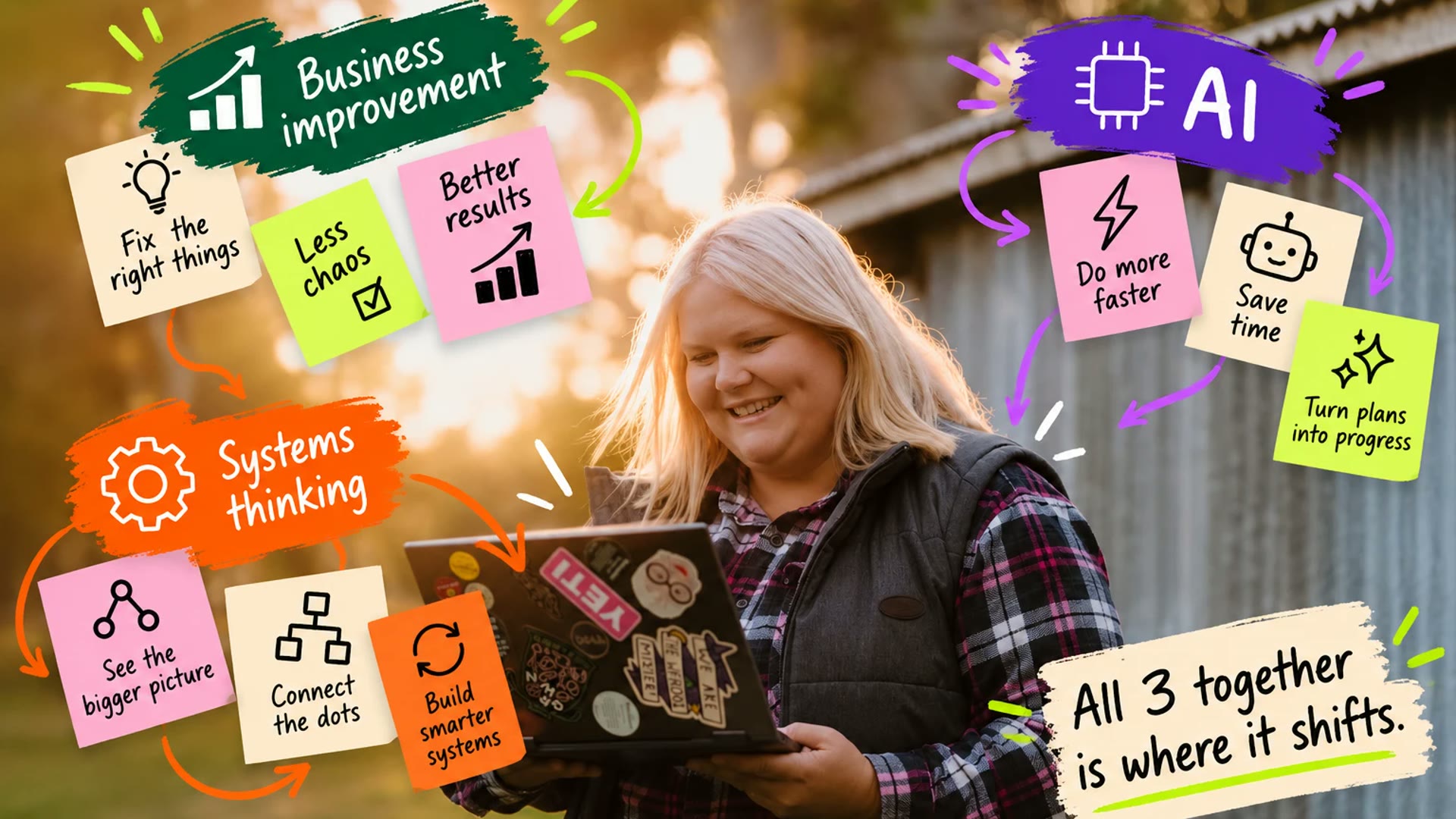
Business improvement. Finding what’s not working, cutting the waste and changing how the work gets done. It’s not glamorous. It’s mostly asking “why do we do it like this?” until someone admits nobody knows.
Systems thinking. Seeing the whole picture. Your business isn’t a to-do list, it’s a set of connected parts. Fix the invoice but ignore how orders come in, and the problem pops up somewhere else. Squeeze one end of a balloon and the other end bulges.
AI. The practical kind. Saving time, sparking ideas, doing more with what you’ve got. It doesn’t need to be scary, and it doesn’t need to cost a fortune. I cancelled 3 subscriptions worth over $100 a month by building my own tools with it instead.
3 ways to be stuck
Most small businesses have 2 of the 3 ingredients. The one you’re missing decides how you’re stuck.
Stuck #1: No AI. You know exactly what to fix. You’ve even written the plan. It’s sitting in a notebook because you don’t have the hours.
Stuck #2: No systems thinking. You fix things fast. The wrong things. The problem moves next door and you’re back where you started by Friday.
Stuck #3: No business improvement. Beautiful automations. Of a bad process. Congratulations, your mess is now on autopilot.
Get all 3 working together and it shifts. You fix the right things, you improve faster, and you build systems that carry the load instead of adding to it. Less chaos. More time. Better results.
On our farm, orders and deliveries went from hours of juggling to opening an app. Website updates went from an afternoon of my time to a single prompt. Not because of a better tool. Because we fixed the right things, connected them, and then let AI do the heavy lifting.
Where to start (this week, not someday)
Pick one process that annoys you every single week. Then:
- Write down every step, including the ones you’d be embarrassed to admit.
- Ask why for each one. Cut anything that exists because “we’ve always done it that way.”
- Look at what it connects to. What feeds into it, and what does it feed?
- Then bring in AI for whatever’s left that’s repetitive, slow or boring.
Most people skip straight to step 4. That’s why it doesn’t stick.
It’s the same loop I use for everything: Scope, Plan, Action, Review, Keep improving. Slow down to go fast. Simple isn’t the same as easy, but it’s usually the answer.
Got a friend with too many AI tabs open and a business that still feels chaotic? Send this to them. It’s not the tools.